
AI-powered sales development representatives (SDR) are reshaping how small and medium European businesses approach lead qualification and outreach. We see more SME owners asking: how do we get the promised time and cost savings, but stay compliant and fully in control? If you’ve tried to connect generic SaaS, you already know the headaches—hidden costs, poor fit, and risky data practices. At Everdados, we’ve walked this path with clients across Europe, and we want to share a straight-talking, experience-backed playbook for AI SDR agent implementation architecture, compliance, lead processing flows, best practices, and risk controls.
Custom automation beats generic at every turn—if you build it with compliance at the core.
Where the pain starts: the cost and risk of generic SDR SaaS
Off-the-shelf SDR tools look tempting at first. But for EU-based SMEs, they can open the door to trouble:
- Non-compliance with GDPR or local cold outreach rules
- Exposure of customer data outside Europe
- No logic to match your workflow or data silos
- Opaque AI decision-making, with no traceability
- Surprise charges when you exceed usage limits
We’ve seen the fallout—broken trust, regulatory headaches, sales teams that lose faith in automation altogether. This is why every playbook must put compliance, clarity, and cost control at its core.
Building your AI SDR agent playbook: step-by-step
We think the magic happens when you combine the latest AI with a custom architecture made for your sales process, tools, and regulatory context. Let’s walk through the framework we use at Everdados to deliver automation that works for European SMEs:
1. Map your data sources and outreach goals
Before anything is built, the first question is: what data will the AI SDR use, and what outreach will it perform? Every SME has unique CRMs, marketing tools, email and SMS systems, and data flows. Start by listing:
- Contact sources (CRM, marketing lists, webforms)
- Channels for outreach (email, phone, SMS, WhatsApp, LinkedIn, etc.)
- Fields or signals that define a qualified lead
- Compliance requirements based on region (GDPR for EU data, ePrivacy, TCPA for calls/SMS into the US, CAN-SPAM for email, etc.)
Always treat your map as a living document—regulations and business goals change. The more you understand your data and routes in advance, the less rework and risk you’ll face later.
2. Design the AI SDR playbook for lead qualification
Now, turn your outreach and qualification logic into a transparent, actionable playbook. We define, in plain language:
- How will the AI identify a new lead from data signals?
- What messages will it send, at what frequency, through which channels?
- How will it respond to replies, objections, or requests for more information?
- When does it escalate a lead to a human?
- How does it withdraw or respect opt-outs, 'do not contact', and suppression lists?
The best playbooks are rigid where the law is strict (like opt-in/opt-out handling), but allow for some flex where human judgment adds value (such as parsing ambiguous replies).
A transparent playbook trains your AI while protecting your reputation.
3. Build a compliant integration architecture
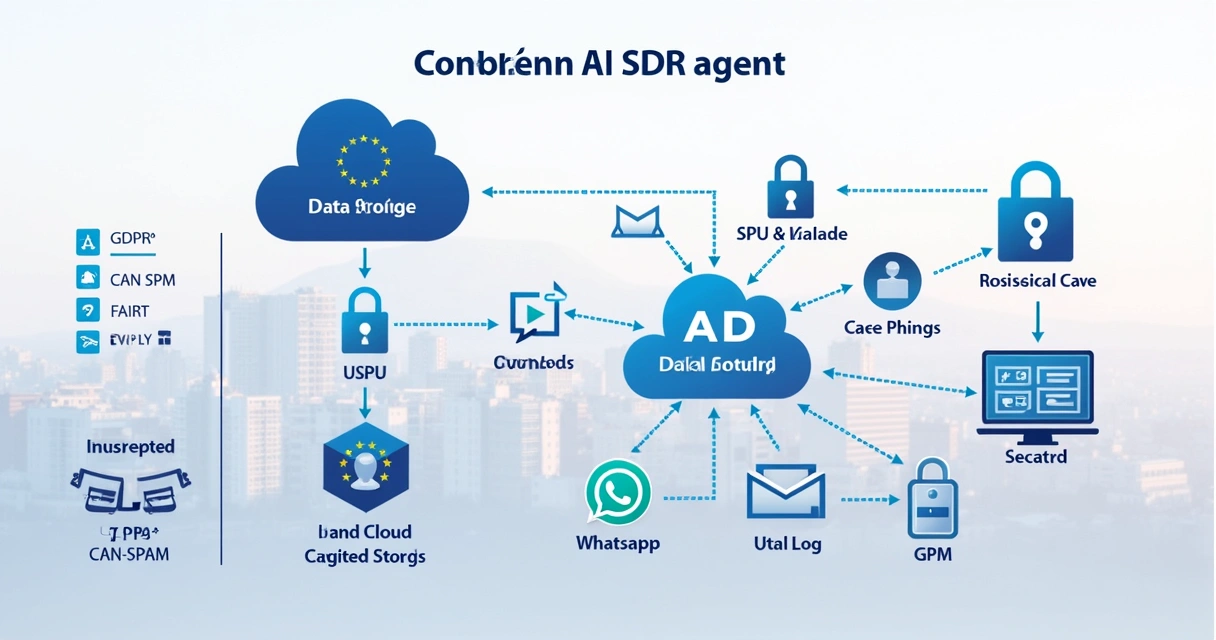
This is the step that keeps us awake at night, and where most generic SaaS falls short. AI SDR integration architecture must do more than move data around. It must prove, enforce, and document compliance at every step. Here’s how we structure it at Everdados:
- Data residency and storage: keep personal data on EU servers unless there’s clear, lawful grounds for export. That means your AI doesn’t just ‘call an API’ that sends data to the US without protections!
- Granular permissions and access controls: make sure your AI SDR and every connected app can only see the minimum data required. Role-based access and audit logs are your best friend.
- API integrations with traceability: use robust APIs for CRM, messaging, or other systems, with every data transfer logged and auditable. Don’t let data vanish into a black box.
- Encryption by default: encrypt data both in transit and at rest. This is now table stakes for GDPR and any customer that asks smart questions.
- Error and incident handling: automatically detect, respond to, and log data mishandling or failed processes.
When these controls are in place, you meet not only GDPR, but can show strong SOC 2 alignment—reassuring for any partner or prospect.
Outreach compliance in 2026: what SME owners must expect
Regulatory rules are only getting more strict. If you’re running (or planning) automated SDR campaigns in 2025 and beyond, these legal issues are non-negotiable:
- GDPR: Consent, data minimization, right to be forgotten, and record-keeping by default, especially for B2C outreach.
- ePrivacy and PECR: Stricter rules on unsolicited messages, especially for SMS and WhatsApp.
- TCPA (for US contacts): Do not call/SMS lists, prior express consent for messages, robust opt-out on every contact.
- CAN-SPAM: Unambiguous sender details, clear unsubscribe, honest messaging content.
- SOC 2: Increasingly requested as proof of secure handling of prospect and customer data.
Outreach automation is only as safe as your weakest compliance link. This isn’t FUD—authorities are doubling down on cross-border investigations, and fines can crush an SME’s budget.
Fingerprint of a robust AI SDR setup for SMEs
What does a 'right fit' architecture look like, compared with the pitfalls we see in generic SaaS? Here is what we build into every SDR AI deployment at Everdados:
- Customizable AI workflows: Match your sales playbook—not a one-size-fits-none bot.
- GDPR-compliant data flows: Keep all contact data in Europe, with transparent processing logs.
- Multi-layered opt-in/opt-out: Syncs with every channel, from CRM to WhatsApp, removing contacts from all outreach and logging preferences.
- Open APIs: Documented, traceable, and designed to minimize data exposure. No hidden syncs or unlogged data hops.
- Full audit trail: Every message, escalation, and suppression event logged and retrievable, retraceable for auditors or complaints.
- Escalation to human, by rule: AI SDR pings a human when things get ambiguous, complex, or risky.
You don’t have to take our word for it; you can see behind the curtain with guides like our integration blueprint for SMEs operating in Europe.
Turnkey steps: implementing your AI SDR, the right way
We get many questions about deployment specifics, so here is our step-by-step sequence for practical AI SDR rollouts. This reduces risk, eases team adoption, and leads to real sales impact:
- Stakeholder kickoff:
- Gather sales, data, and compliance teams.
- Define what “success” means, both in customer terms (response, conversion) and compliance (no data shipped outside EU, no unwanted contacts, etc.).
- Workflow mapping and documentation:
- Map current sales flows, decision points, data handoffs, and compliance gaps.
- Set up a living document that evolves as regulations change.
- AI SDR and API integration buildout:
- Code or adapt AI workflows to your exact playbook, using open, well-documented APIs.
- Skip plugins or native connectors that 'do everything' but expose you to risk.
- Compliance and security checks:
- Penetration tests, data mapping, privacy impact assessments, DPIAs, consent flow validation.
- Document responsibilities: who updates suppression lists, who reviews opt-out handling, etc.
- Human-in-the-loop guardrails:
- Establish rules for escalation (e.g., negative sentiment, suspicious requests, GDPR complaints).
- All AI actions should be logged and reversible.
- Continuous improvement cycles:
- Set review schedules (quarterly or after big regulation updates).
- Use incident logs and sales outcomes to refine messaging, data handling, and escalation logic.
Best-fit automation comes from iteration, not magic formulas.
Best practices for sales AI agent performance and risk control
We think of an AI SDR agent implementation playbook architecture as more than just technology—it’s a system for reliable, compliant growth.
- Monitor all outreach volume and opt-out rates by channel and source.
- Update playbooks in line with regulatory change and team feedback.
- Train both the AI and the human team on escalation patterns—ahead of any client complaint or investigation.
- Build in redundancy: Make sure a single failure (system or human) doesn’t cause prolonged non-compliance.
The clients who get the most from AI SDRs are those who treat these systems as active partners, not black-box robots.

Why custom beats generic: lasting control, fit, and compliance
We see time and again: generic SaaS and plug-and-play agents put business owners at risk. What works for a US-based tech giant does not fit the risk exposure or data reality of a Belgian manufacturer or French retailer. That is why, at Everdados, we go for custom workflows and exact-fit integrations—which keep our clients’ personal data in the right place, and make regulatory fines or customer complaints extremely unlikely.
If you want to see more practical ideas about automation and custom processes, check our articles on AI for SMEs, automation strategies, or custom software deployments. We even cover common failures in business automation, so your SDR project avoids traps others fall into.
Conclusion: set up your AI SDR for growth, not headaches
The future is clear—AI-driven SDR agents are here to save SME owners time, cost, and hassle in qualifying and reaching leads. However, generic solutions bring high compliance risk, poor fit, and hidden costs that European businesses simply cannot bear. The right playbook for AI SDR deployment centers on custom integrations, data flows shaped to your operation, and strict observance of GDPR, SOC 2, and outreach laws.
If you want to replace SaaS sprawl, cut acquisition costs, and take control of your sales pipeline with AI—safely and efficiently—we're ready to help you get there. Get in touch with Everdados to discuss a compliant, future-proof SDR agent solution exactly matched to your business, your workflows, and your budget.
Frequently asked questions
What is an AI SDR agent playbook?
An AI SDR agent playbook is a set of clear, step-by-step instructions that guide your AI-powered sales representative through qualifying, contacting, and responding to leads according to your unique business needs and compliance requirements. This includes decision rules for when to send a message, how to respond to objections, the language to use on each outreach channel, and when to escalate a lead to a human sales agent. It acts as both a recipe for the AI’s actions and a record that your automation follows regulatory and reputational safeguards.
How does AI qualify sales leads?
AI qualifies sales leads by analyzing structured signals—such as CRM activity, past buying history, website behavior, and engagement with prior outreach. The agent uses rules codified in the playbook to assign a quality score or status to new contacts. The process evaluates whether prospects meet defined target criteria, have shown intent or interest, and have not opted out or requested no further contact. When signals are ambiguous or outside its training, the AI flags for manual review, so human judgment can make the final call.
How to ensure compliance with AI outreach?
To ensure compliance with AI outreach you must start by structuring all data handling around GDPR and local rules. This means mapping every source and destination for contact data, encrypting both storage and transfers, and logging all outreach and suppression actions. Implement robust opt-in, opt-out, and consent management at each contact point; audit regularly and set up real-time alerts for suspicious or out-of-policy activity. Finally, closely review playbooks whenever regulations change, and add human escalation for any uncertain case.
What are key steps in integration architecture?
Key steps in integration architecture include: defining and mapping each data source (CRM, marketing platforms, etc.), designing secure API connections with traceable logs, applying strict permissioning (so the AI can only access what it needs), and enforcing data encryption. You also need well documented workflows for error handling, suppression list syncing, and incident response—plus strong human-in-the-loop review for high-risk or ambiguous cases.
Is AI SDR agent implementation worth it?
We think it's worth it—when built right. An AI SDR agent can save SME owners vast amounts of manual time, reconnect lost deals, and cut acquisition costs. The benefits outweigh the risks only when the playbook, architecture, and compliance are shaped to your operation and regulatory context. A generic, plug-and-play SDR bot often brings unwanted costs and risk. A tailored solution, like those we deploy at Everdados, gives you measurable savings, better lead qualification, and peace of mind.