
As European SME owners, most of us have felt the growing pressure of spiraling software expenses. Each year, generic SaaS subscriptions quietly pile up. Promised ‘out of the box’ solutions never quite fit, and sticking to them means sacrificing control, giving up on necessary adaptations, and accepting costly inefficiencies. Yet, the alternative—building custom software—seems daunting, risky, and expensive on the surface.
Is it time to take a fresh look at the build custom software vs SaaS decision framework total cost of ownership 2024 2025? For those wondering if 2026 budgets can justify a shift, or if GDPR compliance demands more ownership, this guide is written from our hands-on experience at Everdados, tackling these decisions with real European SMEs. We aim to show the practical, hidden, and long-term realities so you can make the right choice for your business.
Why SMEs are rethinking SaaS in 2024–2025
Let’s begin where real decisions always start: pain points. What is it about SaaS subscriptions that frustrates so many European SME leaders?
- You start with a basic tier because it’s cheap, but soon need three or four “add-ons” just to work properly.
- Annual price increases arrive without warning and you feel trapped, because migrating is complex.
- Some tools never communicate with each other, creating manual work and more errors.
- Compliance remains a guessing game. If your SaaS stores data abroad, can you guarantee GDPR adherence?
- Most SaaS apps are made for a generic American workflow, not European nuances, not your unique business.
We’ve watched these problems erode margins and morale. A quick calculation shows the real long-term cost is often far higher than the price tag suggests.
You pay not just with money, but with lost time and wasted effort.
If any of these points resonate, you are not alone. We’ve supported dozens of SMEs in untangling stacked SaaS contracts, automating processes, and regaining control with solutions built for them—not for everybody else.
The hidden total cost of SaaS for SMEs
When considering software, it’s tempting to focus on the sticker price. Subscription fees look low, but the total cost of ownership (TCO) tells a broader story.
Total cost of ownership includes not only the fee, but also costs of training, integration, compliance, support, and loss caused by features you’ll never use.Let’s illustrate the true TCO of SaaS for an average SME in 2024–2025:
- Monthly or yearly license fees—which rise over time.
- Paid add-ons, storage expansions, or extra user costs.
- Staff training and onboarding every time the interface changes or you hire new people.
- Lost revenue from inefficient processes and poor fit for your specific market or team size.
- Possible fines or legal risks if cloud storage or integrations don’t strictly comply with GDPR and EU data laws.
- Manual workarounds where integrations between apps fail or data must be migrated by hand.
We have seen European SMEs budgeting for a single “affordable” SaaS, only to end up juggling six distinct tools at twice the expected operational cost within a year. The situation gets worse as business diversifies. Those costs, spread across departments, become hard to spot until the annual review.
Out-of-control SaaS leads to invisible drains on money, time and competitive advantage.
The decision no longer hinges on apparent convenience. It’s about control, risk, and the ability to adapt quickly. In narrowing down solutions for our clients, calculating true TCO, not just first-year cost, always reveals uncomfortable truths.
Understanding the build vs buy decision framework
Both recognized strategy consultancies and voices in the tech community often recommend a structured decision framework to choose between custom software and packaged SaaS. Here’s the practical process we use at Everdados, building on consensus from sources such as Gartner and McKinsey, but with our real-world SME perspective:
- Clarify your business needs. What unique processes, compliance rules, languages, and customer expectations set you apart?
- Map your current pain points with SaaS. Where is money leaking? Which processes are still manual? Where do integrations or compliance fail?
- Estimate all-in SaaS costs vs custom development. Include licenses, migrations, integrations, lost time, manual errors, regulatory risks, future price hikes, and the indirect costs of inflexible solutions.
- Assess long-term adaptability. How well can each option scale and change with your business over 3–5 years?
- Consider risk and control. Who owns your business logic, data, and compliance status: you, or an overseas SaaS?
- Plan for integration and automation now and later. Will future systems connect, or will you always be stuck doing manual exports and copy-paste chores?
By following these steps, the “obvious” cheap solution often turns out more expensive (and less safe) in the medium to long term.
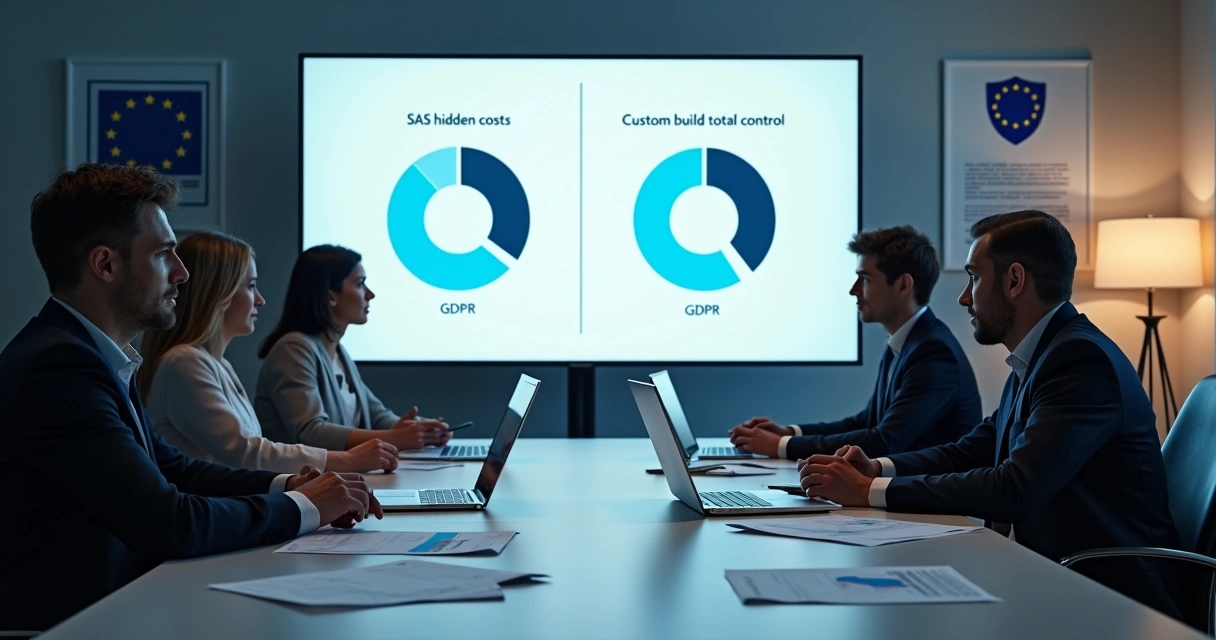
Key factors influencing your 2026 software choice
We have noticed the factors below weigh most heavily for SME owners making the build vs buy decision, particularly in the European context:
GDPR and compliance requirements
For European SMEs, GDPR compliance is not a box-ticking exercise. Data sovereignty is a genuine risk: If your data leaves the EU or is handled by US-based SaaS, you lose control.
Custom software gives you full ownership of your data stack, ensuring GDPR compliance by design, not as an afterthought.We have helped many businesses discover that true compliance often requires more than a privacy policy. Sometimes, only a bespoke solution meets the letter and spirit of EU law.
Long-term total cost of ownership
SaaS vendors bank on the fact that monthly subscriptions look “affordable”, and big costs appear only once you are locked in. However, custom software often reaches break-even with SaaS in 2 to 3 years, especially when ongoing license and workflow duplication are measured honestly. With funding rates stabilizing and inflation affecting everything in 2024–2025, every euro saved matters.
When our team calculates the total cost of software for clients, including downtime, training, support escalation, and compliance checks, the annual spend on SaaS can run far higher than a custom alternative.
Control, flexibility and fit
We constantly hear from SMEs that wish they could automate a process, adapt to their workflow, or connect to a local partner—but their SaaS apps will not allow it.
With custom-built solutions, your business logic shapes the software, not the other way around. Automation gets tailored to your workflow and integrates with the tools your staff already knows, as we explained on our automation blog section.
Data integration and error reduction
Manual re-entry and data cleaning create a double headache: wasted effort and increased risk of mistakes (and fines).
Automated and integrated custom tools shave hours off routine tasks, reduce errors, and give a single source of truth for business data.If you need to hear stories of failed automations and error-prone setups, these real-life examples will help: 7 common failures when automating processes in small businesses.
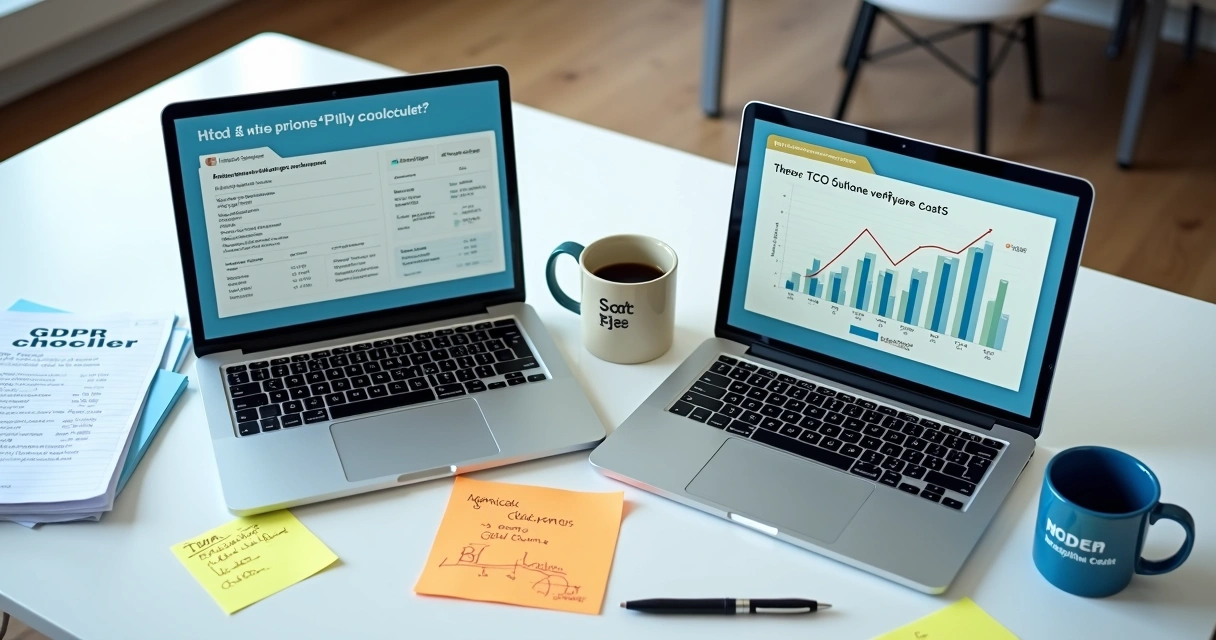
Calculating your real software TCO: a step-by-step guide
The concept of TCO is everywhere, but how can you make it practical as an SME? Here is a process we use at Everdados, and adapt when helping clients:
- Tally up every SaaS subscription (not just the “official” list), including add-ons and hidden charges.
- Estimate soft costs: employee training, lost days for onboarding, and time lost moving data between disconnected apps.
- Include regulatory review costs: audits, compliance checks, and costs of responding to data access or deletion requests.
- Run a scenario calculation: If one key SaaS doubles its price next year, or pulls out of the EU market, what is your cost and risk?
- Estimate the full 3-year cost, not just month-to-month.
When you compare these numbers with a hybrid custom solution—where one platform centralizes business process automation, lead reactivation, and conversational AI agents (as we offer at Everdados), the gap usually narrows or vanishes.
Ownership lowers risk and empowers real progress.
More inspiration can be found in our custom software insights and on our guide for integration challenges for European SMEs: Integrating SMEs with European systems in 2026.
Why SMEs succeed with custom and automated solutions
At Everdados, we’ve noticed that once a business migrates away from generic SaaS to purpose-built solutions, benefits accelerate rapidly:
- Processes that match perfectly to how your team actually works—no more “hacking together” workflows.
- GDPR-by-design, so you never have to worry about new compliance threats.
- Unique competitive features: interfaces, reports, and integrations only your staff (or customers) use.
- Automated lead reactivation and AI-powered client support that saves time and pulls back lost revenue.
- Clearly owning your data, with on-demand access and full auditability, boosting trust and sleep at night.
We lay out specific stories from the frontier between SaaS and custom automation on our AI and automation blog. Through each project, we’ve learned there is no one-size-fits-all answer, but there is a way for every SME to control their own costs and future.
How Everdados makes the difference
Our approach to building custom solutions for European SMEs is shaped by a deep respect for your daily constraints—and your ambition. We don’t just build software. We:
- Create automation that mirrors real European business processes, not wishful American models.
- Factor in every hidden cost: integrations, support, GDPR, language, staff adoption.
- Document and train your team, handing over full ownership and the ability to adapt without vendor lock-in.
- Use automation and AI to reduce manual tasks and errors, freeing staff for higher-level work and direct customer engagement.
You deserve solutions shaped to your needs and budget, not another SaaS subscription out of your control.
Curious how automation, lead reactivation, or AI agents can fit into your current workflow without disruption? You’ll find actionable insights in our automation posts.
Conclusion: Your 2026 software decision, simplified
The build custom software vs SaaS decision framework total cost of ownership 2024 2025 should give every SME owner a chance to step back and see beyond the surface price. What seems like a smart “as-a-service” deal might be slowing your growth, hiding costs you did not budget for, and raising compliance risks you cannot accept.
We believe the right path is not about chasing the ‘trendiest’ model, but about taking control. Custom automation and software, thoughtfully scoped and correctly maintained, can cut costs, bring peace of mind with GDPR, and give your team back their time.
Everdados is here to help your SME break free from wasteful SaaS cycles, claim true ownership, and turn technology into your competitive edge. Contact us to start your journey toward more fit, less waste, and more control, or browse our insights to see how European SMEs are already making these decisions in 2024 and beyond.
Frequently asked questions
What is total cost of ownership for software?
Total cost of ownership (TCO) is the full sum of all expenses connected to using a software solution, including license fees, upgrades, integrations, staff training, support, compliance, and even the cost of downtime or inefficiency. For SaaS, it’s important to include hidden costs and not just monthly payments. For custom software, add both development and long-term maintenance costs.
How to choose custom software or SaaS?
We recommend mapping your unique business needs, pain points, and compliance requirements. Assess all costs—direct and indirect. If standard SaaS doesn’t fit or creates too much manual work or risk, calculate what a tailored solution would look like with ownership, flexibility, and local compliance in mind.
Is custom software worth it for SMEs?
If your business relies on unique processes, faces complex EU regulation, or outgrows generic tools quickly, custom software can lower costs, reduce errors and help scale with confidence. Over a 2–3 year span, the investment usually pays for itself in saved effort and reduced risk.
What decision framework should I use in 2024?
Start by clarifying your must-haves (compliance, integrations, automation), total current costs, and long-term goals. We find the approach described by Gartner and McKinsey—focused on all-in cost, adaptability, and risk—gives the best result. Adjust your calculations for expected inflation, data rules, and your real workflow needs in 2024–2025.
How much does SaaS cost in 2025?
Basic SaaS subscription prices may look steady, but most SMEs see annual increases averaging 10–20%, plus mounting add-on and integration costs. The true cost in 2025 may be two or three times the base fee shown on the website, and that’s before compliance, support, or manual error costs. Always weigh up ongoing expense, not just “advertised” pricing.